The Sacred Valley of the Incas contains many archaeological sites and geographical wonders fundamental to understanding the engineering and culture of ancient Peru. Beyond the classic route to Machu Picchu, there are two attractions that stand out for their technical and visual uniqueness: the agricultural laboratory of Moray and the Salt Mines of Maras (Salineras de Maras).
Can you visit Moray and Maras in one day? Yes, this organized tour is one of the most chosen activities.
In this article, we break down all the technical and service information to organize your visit, in addition to reviewing the most convenient guided circuits. If you are organizing a complete itinerary through the region, we suggest checking the tourist packages in Cusco to resolve transfers and accommodations in a unified way and at the best price.
The Best Way to Visit Maras and Moray: Tours from Cusco
Coordinating public transport, negotiating with local taxi drivers at the "Ramal de Maras" (Maras branch-off), and calculating visit times can fail. Therefore, the most efficient and safest option is to hire a guided service. Guided tours in Cusco resolve door-to-door logistics and include the technical and historical explanation of official specialists, a key factor in understanding the functioning of the agricultural terraces and the geology of the salt mines.
Below, we detail two of the most recommended itineraries:
1. Maras and Moray ATV Tour
The best proposal to add adrenaline to the cultural route. The Maras and Moray ATV tour is a half-day trip (with morning or afternoon departures). It is designed to transit the landscapes of the Sacred Valley in an all-terrain vehicle.
The adventure begins with the transfer from hotels in Cusco and a 50-minute trip to the Cruzpata operations base. There it is time to put on the mandatory safety equipment (helmet and gloves) and attend the technical talk on handling the ATVs (quad bikes) followed by a driving practice on a closed circuit before hitting the road.
The journey is between dirt trails surrounded by mountains and agricultural fields until reaching the Moray Archaeological Complex. After parking the ATVs, you enter the site on foot for a guided tour of the circular terraces.
After the visit, the road towards the town of Maras is resumed. To avoid accidents on the narrow ledge road (in addition to preventing salt contamination with engine dust), ATVs cannot descend to the Salt Mines. Therefore, the vehicles are left at a safe point near Maras, and the descent to the salt mines is done by van.
2. Cultural and Historical Tour: Chinchero, Maras and Moray
If the goal is to delve into Inca history, textile traditions, and landscape photography, the classic half-day tour to Chinchero, Maras, and Moray is the indicated option. This circuit optimizes time on the road to the maximum, adding a strategic stop of very high cultural value before reaching the main sites.
The tour starts early from Cusco towards the Sacred Valley. The first stop is the town of Chinchero, located at 3,762 meters (12,342 feet) high and world-renowned for the quality of its weavers.
During the visit to the Textile Interpretation Center, the women of the community demonstrate live ancestral weaving techniques. Alpaca wool is washed with the Andean root saqta (a natural detergent) and vibrant colors are composed of natural dyes, such as carmine red extracted from the cochineal insect.
Before moving on, it is time to visit the exterior of the Chinchero colonial church, built directly on the foundations of Inca palaces.
Then follows the transfer to the Moray archaeological complex to explore and understand the functioning of the agricultural laboratory. Finally, the tour heads to the Maras Salt Mines to observe the thousands of evaporation pools, understand the cooperative irrigation system maintained by local families, and have free time to take photographs or buy salt directly from the producers.
Routes and Transport: How to Get to Maras and Moray from Cusco
Transport logistics in the Sacred Valley requires attention to detours and road conditions. If you want to know how to get to Maras and Moray from Cusco on your own, there are two alternatives: private vehicle, or combining public transport with taxis.
The total journey from Cusco to the town of Maras is about 50 kilometers. The car trip starts northwest along National Route 3S, the same highway that connects with Urubamba and Ollantaytambo. This first section is completely paved and in good condition.
After about 45 minutes you reach kilometer 50, where the "Ramal de Maras" is located. Here you have to take a detour to the left along a secondary road that leads directly to the town center in 10 minutes.
To travel from Cusco to Maras and Moray by public transport, you must leave from Pavitos street in Cusco, from where minivans (colectivos) depart towards Urubamba. Once the ticket is paid, you have to tell the driver to stop at the Ramal de Maras. Once at that crossing, on the main route, there are always local taxis waiting to take tourists to the town of Maras, the salt mines, or the Moray complex.
The Town of Maras and the Salt Mines: Location and Tourist Services
The town of Maras functions as the logistics center of the area. Its architecture is characterized by adobe facades and stone portals that preserve noble coats of arms from the colonial era. The gastronomic offer here is basic; you will not find large tourist restaurants, but rather picanterías and local diners offering menus of the day based on quinoa soups, trout, and Andean stews.
Facilities and Entry to the Maras Salt Mines
About 5 kilometers northwest of the town are the famous Salineras de Maras. The access road from the urban center is a packed dirt road, narrow and with downhill curves towards the Vilcanota River ravine. If you go by car, driving must be at low speed due to dust and the constant flow of tourist minivans.
The site is composed of more than 3,000 evaporation pools carved into the mountainside. An underground hyper-saline water spring feeds these terraces, and through sun exposure, the water evaporates leaving salt crystals that locals harvest by hand.
Services at the Maras Salt Mines
Entry: Access to the Salt Mines is not included in the Cusco Tourist Ticket (Boleto Turístico). A separate entrance fee must be paid at the control booth (approximately 20 soles per person, payment in cash only).
Parking: Near the entrance, there is a dirt parking lot enabled for private vehicles and tourist transports.
Facilities: The enclosure has paid public restrooms (entry usually costs 1 sol).
Commerce: Right before the viewpoints, there is a commercial corridor where the producers themselves sell bags of Maras pink salt, snacks, and bottled water.
Accessibility and rules: For conservation and health reasons, walking along the edges of the salt pools is no longer allowed. The tour is done through signposted walkways and upper viewpoints. Access for people with reduced mobility is very limited due to stairs and uneven terrain.
Moray Archaeological Complex: What is the Visit to the Inca Terraces Like?
Moray is located about 7 kilometers southwest of the town of Maras. The road connecting them is a gravel route that crosses extensive agricultural plateaus. The vehicle journey takes about 20 minutes.
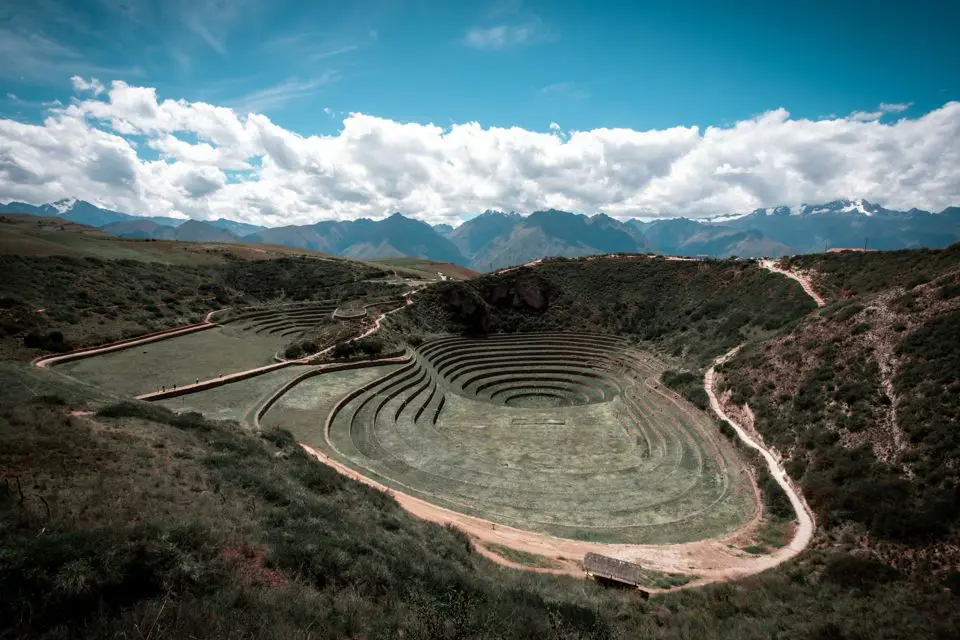
Moray is not a fortress or a citadel, but an Inca agricultural research center. It consists of a series of gigantic natural depressions in the ground that were terraced with stone walls (andenes) in a concentric circular shape.
The genius of this construction lies in its microclimate: topographical studies showed that there is a temperature difference of up to 15 °C (27 °F) between the upper terrace and the bottom of the main circle (known as Qochamuyu). This allowed the Incas to simulate different ecological altitudes and acclimatize crops such as potatoes, corn, and coca leaves.
Services in Moray
Entry: To enter Moray it is mandatory to have the Cusco Tourist Ticket (BTC). The Partial Ticket for Circuit III (which includes Pisac, Ollantaytambo, Chinchero, and Moray) or the Integral Ticket is required. Individual tickets are not sold just for this site.
Facilities: At the main entrance is the ticket control booth and a block of free public restrooms for those presenting their ticket. There is also a large parking area.
Restrictions: There is no sale of food or beverages within the archaeological area to guarantee its preservation. Therefore it is key to bring your own water.
Climate and protection: Being at 3,500 meters high and on an open plain, there is no shade of any kind. The use of sunscreen, dark glasses, and a hat is mandatory all year round, as well as bringing a windbreaker jacket.
Circuit: Perimeter trails are clearly delimited and fenced. It is strictly forbidden to descend to the bottom of the terraces to avoid erosion of the ancestral soil.
Final Tips for Your Trip to the Sacred Valley
Regardless of whether you choose to do the journey on your own or through a guided tour, there are important geographical and climatic factors to consider:
Moray and Maras are located above 3,300 meters above sea level. It is imperative that you spend at least a day or two of prior rest at your accommodation in Cusco or in the Sacred Valley itself to acclimatize the body before undertaking hikes or adventure excursions. Stay hydrated and avoid heavy meals before the tour.
The dry season (from May to October) is the ideal time to visit Maras and Moray. The dirt roads are firm and the sun highlights the radiant white of the salt mines. During the rainy season (from November to April), the water in the salt mines can turn brown due to washed-down sediments, and the gravel routes to Moray can get muddy and hinder transfers.
Make sure to withdraw cash in Cusco or Urubamba before starting your tour. Entry to the Maras salt mines, use of public restrooms, and purchases from local artisans require local currency (Peruvian Soles). The internet signal in the salt mines area is unstable, so card payment terminals or virtual wallets rarely work.
Published by Has Chacon on 08/06/2026